# Introduction

Welcome to Surf.\
\
Here's a quick 10 second introduction.

* Open-source pooled lending on Cardano
* Isolated, perpetual pools keep risk contained per market
* One-click leverage to go long or short without borrow looping
* Deep liquidity markets with a fast, mobile-friendly UX
* No emissions; protocol fees shared with LPs and SURF stakers
* Lead developer built Bodega smart contracts; advised by leaders from Bodega and Strike
* Smart contracts are open source and audited twice, including [Anastasia Labs](https://x.com/AnastasiaLabs)
* V2 including multiple new features and enhancements is planned for Q1 2026

\
For more links and resources, see [here](https://linktr.ee/surfdefi). \
\
Thank you for the support and we hope you enjoy using the platform.&#x20;


# 1. What Is Surf?

Surf is an AMM-style pooled-lending protocol on Cardano that lets you lock ADA or Cardano-native tokens (CNTs) such as SNEK as collateral to borrow ADA or stablecoins (like USDM), while LPs earn yield on their deposits. Pools are *isolated*, so the risk of any token is contained inside its own market. Loans are *perpetual*, so borrowers can repay whenever they like, and lenders can withdraw whenever liquidity is free.


# 2. Quick‑Start Guide

<figure><img src="/files/bTwomlCVJod5at3REKPL" alt=""><figcaption></figcaption></figure>

1. Connect a Cardano wallet that supports smart contracts (Eternl wallet is Recommended on desktop, Vespr wallet on the Mobile).
2. **(Optional)** To earn passive yield, pick a pool and click **Supply** to deposit tokens.
3. Need liquidity? Click on any pool’s **Borrow** button (no prior supply required), type how much you want, then add enough collateral until the health factor is satisfactory.
4. Track your Loan Health Score of your Borrow positions in the Portfolio tab (needs to stay above **1.0** to avoid liquidation).
5. Add collateral anytime, or repay the loan in full whenever you’re ready.

*Orders normally settle within two minutes. If yours lingers, it likely means the pool lacks free liquidity or the market’s batcher is temporarily down. You can cancel while it’s pending, but note the 1 % loan‑opening fee is manually refunded—open a support ticket instead of cancelling on a whim.*


# 3. Supplying Assets

Supplying the pool’s lendable token mints fTokens that track your share (e.g., supplying ADA to the ADA/SURF pool mints fADA‑ADA/SURF). Every pool has its own flavour of fToken—so fADA from ADA/SNEK is distinct from fADA in ADA/SURF.

How you earn:

* The fToken price ticks up whenever borrowers repay—exact timing depends on user behaviour.
* Cardano staking rewards flow into the pool every five days, boosting fToken price.
* A share of Loan Opening fees and Liquidation fees will also be contributed to the pools on a regular basis.

Flexibility:

* You may add or withdraw supply anytime, even if you also have an open loan, so long as the pool has enough free liquidity.
* Withdrawals settle through the same order queue; if liquidity is tight, the order waits until funds are available.

No collateral token minted: Locking SNEK/SURF/etc. as collateral does not mint a new token—it’s simply held until you repay.


# 4. Borrowing Assets

Here is how you can borrow assets on Surf:

1. Click Borrow on your chosen pool.
2. Enter the amount you want, then add an amount of collateral you're happy with. Use the Min, R(ecommended), or Max buttons to fill these out for you.
3. Hit Borrow and sign the wallet pop‑up—your request is queued.
4. When the batcher processes the order, liquidity arrives in your wallet and the loan’s fixed APR is stamped. You can view it anytime in Portfolio → Borrow Positions → Interest Rate.

Key points

* APR is locked when the order executes, not when you click Borrow—if utilisation rises before execution, later borrowers may pay a higher rate.
* 1‑day interest padding → A full day’s interest is added to the loan the moment it opens. This discourages ultra‑short loans aimed only at farming Cardano staking rewards.
* You can top‑up collateral at any time (instant transaction, no queue), but you cannot remove collateral until the loan is fully repaid.
* Keep an eye on the *current liquidation price* shown in both the Borrow and Add‑Collateral pop‑ups; we’ll add it to the Borrow Position table soon.


# 5. Leverage

**One-Click Leverage** is Surf’s simplified leverage product that lets users open 1.01× – 3.33× leveraged long or short positions efficiently on Cardano native tokens directly through the lending protocol, eliminating the need for manual borrow looping.

<div data-with-frame="true"><figure><img src="/files/iVL65MIm4TIBMCYCfWH8" alt=""><figcaption></figcaption></figure></div>

#### How It Works

One-Click Leverage automates the *borrow looping* process normally done by advanced users:

* **Long**: Supply a token (e.g., SURF, SNEK) as collateral, borrow ADA, and automatically swap it back for more of the same token, which is then added to the collateral of the borrow position.\
  → This increases your exposure to the token’s price movement.
* **Short**: Supply ADA as collateral, borrow a token, and automatically sell it for ADA, which is then added to the collateral of the borrow position.\
  → This allows you to profit if the token’s price falls.\
  → This is also a way to Long ADA, when the token you're borrowing is one of the stable coins (e.g., USDM, USDA, DJED) or other assets such as BTC, iETH , etc.
* **Token Swap:** The borrowed amount is automatically swapped for more of the collateral token using a DEX aggregator, ensuring optimal routing and minimal slippage. Surf only estimates the resulting additional tokens, **Health Factor**, and **Liquidation Price**, based on current market data.
* **Repayment:** Works exactly the same way as for normal borrows on Surf.\
  Once the **principal + interest + closing fee** are repaid, you regain the collateral locked in your leveraged position.

#### Why It’s Different

Unlike typical leveraged trading products:

* Surf’s leverage positions are **on-chain** and **non-custodial**.
* There’s **no order book or counterparty** — leverage is powered entirely by Surf’s lending pools.
* Positions have **no fixed maturity**, giving users flexibility to hold or close anytime.

#### Which Assets Can You Long or Short?

* **Long:** Any Cardano Native Token (**CNT**) that has an **ADA/CNT market** on Surf, depending on available supply in that market.
* **Short:** Any **CNT/ADA market** available on Surf can be used for shorting, depending on available supply.

#### Parameters

* **Leverage range:** 1.01× – 3.33× (varies by market)
* **Opening fee:** 1% of the borrowed amount
* **Dex Aggregator fee**: a mostly refundable 10 ADA fee which is used to ensure the dex aggregator swap goes through smoothly. This fee is refunded at the end of the leveraged borrow loop.
* **Interest rate:** Fixed at the time of the borrow, based on pool utilization
* **Liquidation threshold (LTV):** \~40%-85% (adjusted per pool)
* **Liquidation fee:** 15% applied on liquidation

#### Liquidations

Positions are automatically liquidated when the **Health Factor** falls below 1.0.\
Health Factor is determined by the ratio between collateral value and borrowed value, adjusted by the pool’s liquidation threshold.

#### Use Cases

* **Amplify exposure** to tokens you’re bullish on.
* **Hedge positions** by shorting volatile assets.

#### Risks

Leverage amplifies both gains and losses. If your collateral value drops close to your borrow value, your position may be liquidated. Always monitor your **Health Factor** and borrow responsibly.


# 5. Liquidations

When the value of your collateral falls too close to—or below—the amount you’ve borrowed plus interest, the loan becomes unsafe for the pool. At that point Surf automatically “liquidates” the position: it sells just enough of your collateral to repay the debt and a small fee, then returns any leftovers to you. Liquidations protect lenders and keep the pool solvent without needing human intervention.

**Why They Happen**

Surf uses a *Health Score* to measure how safe a loan is:

Health Score = (Collateral Value × Collateral Factor) ÷ (Borrowed Value + Accrued Interest)

* \>1.0 → Safe You’re above the liquidation line.
* ≤1.0→ At Risk Surf’s bot auto-liquidates: it repays the debt and sells enough collateral to cover it.

**What the Surf Liquidator bot does**

1. Automated bot repays the entire under‑collateralised debt (principal + accrued interest) and triggers a 15 % liquidation fee.
2. The protocol immediately sells enough collateral on‑chain to cover the debt plus the 15 % liquidation fee.
3. Any collateral left after paying debt and fee is automatically returned to the borrower.

**What It Means for You**

* Keep an eye on your Liquidation price and Health Score. Topping up collateral pushes it higher; when you no longer need the loan, repay the full amount to close it.
* A health buffer of 1.5 – 2.0 is usually considered comfortable.

**ADA / SNEK Loan liquidation walk-through**

*(min LTV 48 %, liquidation 60 %)*

| Step                                    | Numbers (example)                                                                                                                                                                                                                                      |
| --------------------------------------- | ------------------------------------------------------------------------------------------------------------------------------------------------------------------------------------------------------------------------------------------------------ |
| **1 · Open the loan**                   | Borrow **1 000 ADA**. Post **≈ 416 700 SNEK** (worth **2 083 ADA**) so your starting LTV is **48 %**.                                                                                                                                                  |
| **2 · Interest ticks up**               | Suppose the fixed APR on this loan is **5 %**. After 180 days, accrued interest ≈ **25 ADA**. Your **borrow balance is now 1 025 ADA.**                                                                                                                |
| **3 · LTV rises even if price doesn’t** | New LTV = 1 025 / 2 083 ≈ **49.2 %**—no price move needed.                                                                                                                                                                                             |
| **4 · Price move to liquidation**       | Liquidation fires when LTV hits **60 %**. With 1 025 ADA owed, that happens if your SNEK collateral value falls to **1 708 ADA**. That’s a **\~18 % price drop** from the day-one level (slightly less than the 20 % drop if no interest had accrued). |
| **5 · What the protocol does**          | The bot repays **1 025 ADA** *(principal + interest)*, adds a **15 % fee** (≈ 154 ADA worth of SNEK), sells just that amount of SNEK, and returns any leftover tokens to you.                                                                          |

**Oracle & Price-Feed Basics**

Surf runs its own oracle service that pings several public feeds, most notably DexHunter and Charli3 (C3) API, every few seconds. Having more than one feed gives us redundancy: if one API lags or spikes, the others keep the price stream healthy. The oracle only stores the most recent quote for each token and publishes it on-chain when a liquidation check needs a fresh price.<br>


# 6. Fee Structure

Surf aims for zero-surprise costs. Here’s a full breakdown of every fee on the platform:

<table data-header-hidden><thead><tr><th valign="middle"></th><th valign="middle"></th><th valign="middle"></th><th valign="middle"></th></tr></thead><tbody><tr><td valign="middle">Action</td><td valign="middle">Who Pays</td><td valign="middle">Where It Goes</td><td valign="middle">Typical Rate</td></tr><tr><td valign="middle">Loan‑opening fee</td><td valign="middle">Borrower</td><td valign="middle">70 % to SURF stakers, 30 % to liquidity providers</td><td valign="middle">1 % of borrowed amount</td></tr><tr><td valign="middle">Borrow interest</td><td valign="middle">Borrower</td><td valign="middle">90 % to liquidity providers, 10 % to protocol reserve</td><td valign="middle">Dynamic (utilisation‑based), fixed at the time the loan is initiated</td></tr><tr><td valign="middle">Protocol fee on interest</td><td valign="middle">Borrower</td><td valign="middle">100 % to SURF stakers</td><td valign="middle">20 % of interest owed</td></tr><tr><td valign="middle">Liquidation fee</td><td valign="middle">Borrower (only if liquidated)</td><td valign="middle">70 % to SURF stakers, 30 % to liquidity providers</td><td valign="middle">15 % of repaid debt value</td></tr><tr><td valign="middle">Network (Cardano) fees</td><td valign="middle">Everyone</td><td valign="middle">Cardano validators</td><td valign="middle">≈ 0.17 – 0.25 ADA per tx</td></tr></tbody></table>

No deposit or withdrawal fee—you can supply or redeem tokens at any time for just the standard Cardano tx cost.

***Note: All fee percentages and allocations may be adjusted in future governance updates.\****


# 7. Risk Parameters

Below are the current loan‑to‑value (LTV) settings for each pool launched so far. The **Minimum LTV** is the highest LTV you can open a loan with; the **Liquidation Threshold** is the LTV % which triggers liquidation of a borrow position.

<table data-header-hidden><thead><tr><th valign="middle"></th><th valign="middle"></th><th valign="middle"></th></tr></thead><tbody><tr><td valign="middle">Pool</td><td valign="middle">Liquidation Threshold (%)</td><td valign="middle">Minimum LTV (%)</td></tr><tr><td valign="middle">ADA/SURF</td><td valign="middle">50</td><td valign="middle">40</td></tr><tr><td valign="middle">ADA/SNEK</td><td valign="middle">60</td><td valign="middle">48</td></tr><tr><td valign="middle">ADA/USDM</td><td valign="middle">80</td><td valign="middle">64</td></tr><tr><td valign="middle">USDM/ADA</td><td valign="middle">80</td><td valign="middle">64</td></tr><tr><td valign="middle">ADA/STRIKE</td><td valign="middle">65</td><td valign="middle">40</td></tr><tr><td valign="middle">ADA/BODEGA</td><td valign="middle">65</td><td valign="middle">40</td></tr><tr><td valign="middle">ADA/IAG</td><td valign="middle">65</td><td valign="middle">40</td></tr></tbody></table>

Formulas

LTV = Borrowed Value ÷ Collateral Value

Health Score = Liquidation Threshold ÷ LTV

A Health Score above 1 means your position is safe; at or below 1 puts it in the liquidation zone.\*


# 8. Interest‑Rate Model

<figure><img src="/files/ha0DE2byMu7Z1ENoKRkW" alt=""><figcaption></figcaption></figure>

The jump-rate curve and the “Estimated APY” figure you see in the dApp today only reflect the interest paid by borrowers. They do **not** yet include the share of the loan-opening fee or the liquidation fees that go back to LPs and SURF stakers. Once we have enough real-world data on those fees, we’ll fold them into the APY calculation and update both the chart and the dApp display.

Interest rates are Fixed for your loan — When you borrow, the current pool rate is locked for the lifetime of your position. Later borrowers may pay more (or less) as utilisation changes, but your rate stays the same until you fully repay.\*

**Why this model benefits borrowers**

* Predictable repayments → once your order executes, your APR never spikes—even if utilisation later hits 99 %.
* Low base rate → pools start at just 5 % APR, incentivising borrowers to borrow aggressively when loans are affordable.
* Gentle slope below 90 % utilisation → interest climbs slowly, so even at 70–80 % pool usage rates remain competitive.
* Borrow‑first advantage → early borrowers can lock in a cheap rate and keep it, while fresh borrowers shoulder higher costs if the pool tightens.

Despite the steep slope after the 90 % kink, APR remains reasonable at such high utilization levels, peaking at 25%. At such levels, borrowers would be encouraged to close their loans quickly. LPs and stakers on the other hand would benefit from faster repayments and additional opening fees at these levels.

**Why this model also rewards lenders**

As the pool fills, the borrow rate—and your yield—goes up automatically. Once utilisation passes 90 %, the rate climbs even faster, while 10 % of every interest payment is peeled off into a reserve that acts as insurance/emergency fund.

Remember, though, interest actually hits the pool only when borrowers repay. If you withdraw your supply before that happens, you give up your share of those payouts. Lending on Surf V1 is designed with long-term LPs in mind.


# 9. Practical Examples

Below are five common ways people might use Surf's isolated, perpetual pools. They’re illustrations only, not financial advice.

**1. Long ADA with USDM**\
• Borrow USDM from the ADA/USDM pool using ADA collateral.\
• Swap the borrowed USDM for more ADA.\
• If ADA’s price goes up, sell just enough ADA back to USDM to repay the loan and keep the extra ADA—effectively boosting your ADA stack without selling the original coins.

**2. Short ADA while holding stables**\
• Deposit USDM into the USDM/ADA pool as collateral.\
• Borrow ADA and immediately swap it for USDM.\
• If ADA’s price drops, buy it back at the lower price, repay the loan, and keep the difference—letting you profit from a decline while sitting in stablecoins.

**3. Leverage into SNEK**\
• In the ADA/SNEK pool, lock SNEK as collateral.\
• Borrow ADA and swap it for more SNEK.\
• Optionally loop the step once or twice (carefully) or wait for SNEK to rise, then repay—growing your SNEK position without new cash.\
• Bonus step: add part or all of the newly bought SNEK into the same loan as additional collateral; this lifts your Health Factor and pushes the liquidation price lower.

**4. Passive ADA yield**\
• Supply ADA to a pool where ADA is the lendable asset (for example, ADA/SURF).\
• Hold the fADA you receive; its value climbs as borrowers pay interest, 5-day Cardano staking rewards arrive, and as the pool’s share of the loan-opening fee plus  a % of the liquidation fees are credited.\
• Withdraw whenever you like—earning a higher, hands-off APY than solo ADA staking.

**5.  Yield spread Arbitrage USDM**\
• In Surf's USDM/ADA pool, use ADA as collateral to borrow USDM at a fixed 5 – 12 % APR (when utilisation is under 90%).\
• Move that USDM to Liqwid and supply it there, where it currently earns about 14 % APY. \
•  To close the loop, withdraw the USDM (plus the interest you earned) from Liqwid, use part of it to repay the Surf loan in full, and keep whatever surplus is left.


# One-Click Leverage Demo

{% embed url="<https://youtu.be/6T0Kuwhmdfs>" %}


# 10. SURF Token Utility & Tokenomics

## SURF Utility <a href="#id-6fd8" id="id-6fd8"></a>

The Surf Token (SURF) is built to have simple and effective utility. The purpose of holding the token is to give value back to token holders from success of the protocol, mostly including fees from protocol revenue.

There are **no emissions** for the SURF token, and 100% of protocol revenue goes to either liquidity providers or SURF stakers.

1. **Staking:** SURF holders can stake their tokens and earn a percentage of protocol fees.
2. **Governance:** SURF holders can participate in the protocol’s governance, voting on important decisions such as upgrades, new feature implementations, and changes to fee structures.
3. **Collateral:** Use SURF as collateral to have access to a higher liquidation buffer for enhanced protection. For example, you can only be liquidated at a health factor of 1.0, as opposed to the standard 1.10 for normal users, potentially **giving users an edge** in sharp price moves and thinner liquidity markets.
4. **Pool Creation:** Gone are the days of arduous governance procedures to spawn new lending markets. Any user holding a pre-determined amount of SURF will be able to spin up lending markets for a one-time fee. Creators will be able to earn a percentage of all interest paid in their pools, while the spawn fee is split between the DAO treasury and a burn address, adding steady deflationary pressure to SURF. By **democratizing market creation** and eliminating lengthy governance process, teams of any size can **rapidly deploy pools** for niche tokens, short-selling strategies, event-driven vaults, and other experiments, with systemic risk contained within each standalone market.

## Tokenomics <a href="#ff9b" id="ff9b"></a>

SURF is the platform token for the **Surf** protocol. There are a total of 25 million (25,000,000) SURF tokens. The allocation for SURF is detailed below from largest to smallest:

* **Public Sale:** 68% (17,000,000 tokens)
* **Team and Advisors**: 15% (3,750,000 tokens)
* **Liquidity:** 12% (3,000,000 tokens)
* **DAO**: 5% (1,250,000 tokens)

The total public allocation is 85%, with 15% for team and advisors.

The distribution is as follows:

**Tokenomics Chart**

Zoom image will be displayed

<figure><img src="https://miro.medium.com/v2/resize:fit:1400/1*QEGRexR7YwCqCpI97cEiLw.png" alt="" height="467" width="700"><figcaption><p>Surf Tokenomics</p></figcaption></figure>

**Emissions**

Emissions are simple and easy to understand. There will be 80% of tokens initially in circulation (public + liquidity). The additional 15% from team allocation will be fully unlocked after 24 months (full details below) for a circulating supply of 95%, and the final 5% (DAO treasury) will be decided by community members at a later time.

**Vesting**

DAO vesting will be entirely up to the voting of SURF holders. This can be used for anything the community sees fit such as incentives, initiatives, funding future development, etc.

Team vesting is simple. Starting from the token generation event, there is a 6 month period where there are no unlocked tokens. After that, tokens will unlock linearly monthly over the span of 18 months, for a total of 24 months or 2 years vesting from the TGE.


# 11. Governance

*Coming soon (voting, managing DAO treasury funds, proposing parameter changes).*


# 12. Security & Audits

*Our first audit was completed  by the creator of* [*Helios*](https://x.com/helios_lang) *before launching on mainnet and was published* [*here*](https://github.com/flow-lending/flow-lending-smart-contracts/blob/main/audits/flow_lending_audit-2025-07-07.pdf)*.*

*Our second audit is done by* [*Anastasia Labs*](https://x.com/AnastasiaLabs) *and is currently in progress.*

*Coming soon (bug‑bounty links).*


# 13. Glossary & FAQ

*Coming soon.*


# 14. Roadmap

In the coming months, Surf's mission is clear: become **the top Cardano dApp in total value locked (TVL)**.

Since our mainnet launch, Surf has seen the **largest influx of ADA of any Cardano protocol**, with over **12M ADA** deposited. This is an excellent start, and we’re currently 8th across all of Cardano, but now we’re setting our sights higher.

Currently, Liqwid sits at the top with a TVL of **110M ADA**. That means Surf is around **10% of the way there**. In this article we detail our plan to secure the next 100M ADA in TVL and claim the top position.

Here are some overall bullet points and assumptions that shape our roadmap and strategy for growth.

* **One of the highest demand apps on Cardano:** Platform-wide utilization is above 65%, making Surf one of the most efficient protocols on Cardano. We expect this utilization rate to stay consistent as liquidity grows, so prioritizing lenders should help us get to where we want to go. This includes good returns, timely payouts, and institutional grade standards for security and reliablity, similar to AAVE.
* **Dynamic interest rates will make the platform even more attractive** for both lenders and borrowers. Paired with more frequent payouts, Surf will become the go-to platform for supplying liquidity. This will largely come in the form of Surf V2, which we have started working on and should start sharing the first development updates by the end of this month.
* **Additional improvements will be made for borrowers** as well, with partial repayments and enhanced collateral management delivering a smoother borrowing experience.
* **Community pool creation** will enable a steady flow of listings from community members, especially for hot tokens. Communities can rally around their project’s token and will lead to easy exposure of our lending services.
* **Multi-collateral support** will expand the strategies and options for our users. This will make Surf a one-stop-shop for both isolated lending pools and multi-collateral lending pools.
* **SDK & API** — this should help us get Surf all around the ecosystem, similar to how you can easily swap with the DexHunter API. Major wallet integrations will make lending and borrowing readily available everywhere.

Those are some of the main things we think will help get us to the 100M ADA TVL.

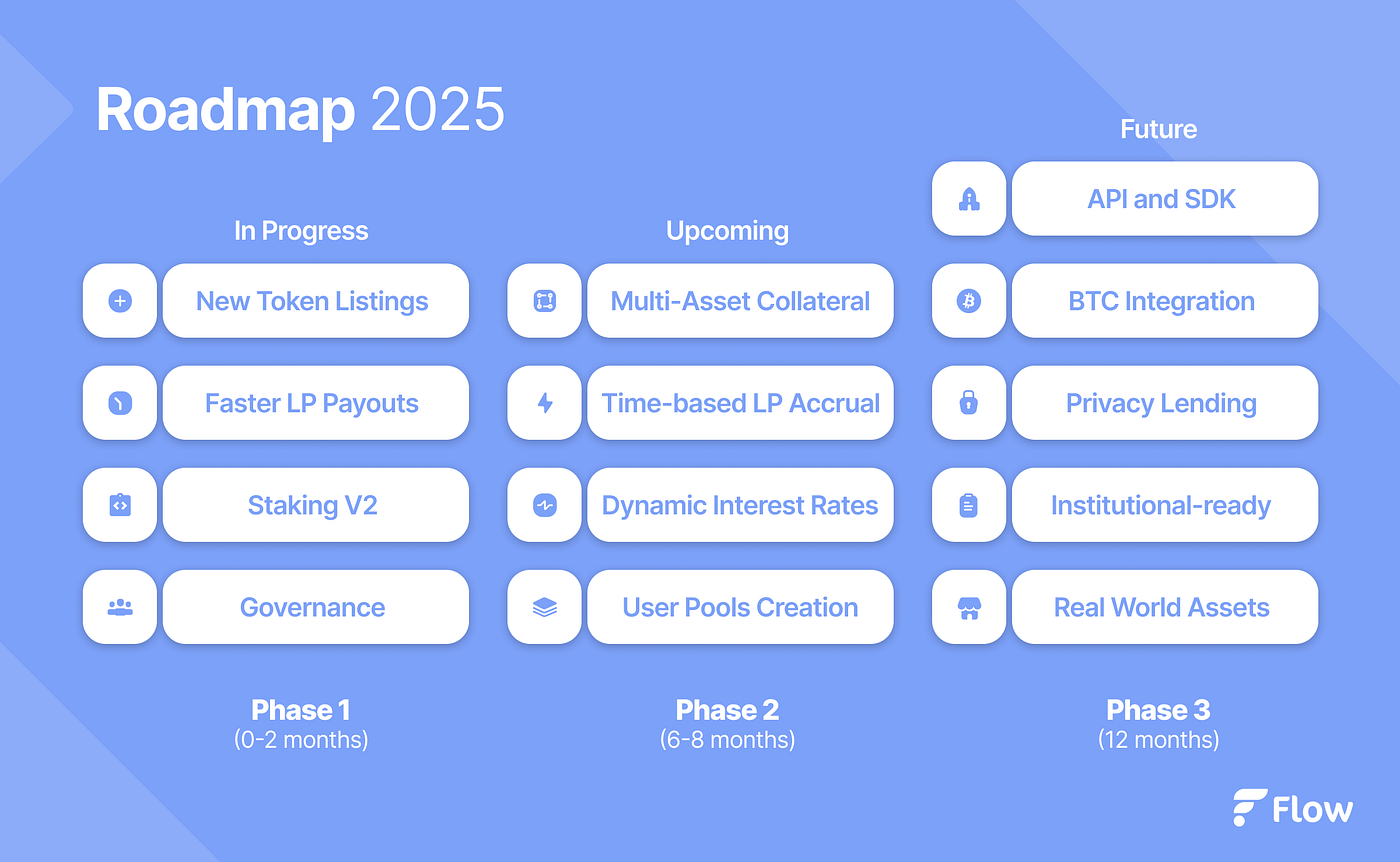
Below is a more detailed roadmap with our long term development and growth plan.

Press enter or click to view image in full size

<figure><img src="https://miro.medium.com/v2/resize:fit:1400/1*AUPDPZ1UtqtZT9KnxTL3Nw.png" alt="" height="432" width="700"><figcaption><p>Surf Roadmap 2025</p></figcaption></figure>

### Phase 1: Surf V1 Enhancements (0–2 months) <a href="#b316" id="b316"></a>

1. **Additional Token Listings**

We will rapidly expand our supported assets to increase borrowing and lending opportunities, attracting a wider user base and more liquidity.

**2. Faster Liquidity Provider Payouts**

While borrower repayment timelines are flexible and unpredictable, we can speed up the release of opening fees to liquidity providers. This will make providing liquidity more attractive, increasing TVL and protocol revenue.

**3. SURF Governance**

Launching governance forum and proposal portal will allow SURF holders to help shape new listings, interest rate models, and other key parameters, all in a timely and efficient manner.

4\. SURF Staking improvements

SURF tokens locked in loans as collateral will be counted towards stakers' staking balance, rewarding ownership and usage of the SURF tokens in the protocol.

### Phase 2: Surf V2 (6 months) <a href="#id-4345" id="id-4345"></a>

1. **Time-based LP accrual model**

Rework the LP reward model to increase continuously, not only at repayment events. LP value becomes smoother and more predictable.

**2. Multi-Collateral Support**

Surf will allow borrowing against multiple assets simultaneously, enabling more sophisticated strategies and deeper market liquidity — similar to Aave’s model. This will make Surf home to both isolated lending pools and mulitcollateral pools.

**3. Dynamic Interest Rates**

We plan to move from fixed utilization-based rates to **fully dynamic rates** driven by real-time supply and demand. This ensures lenders get optimal returns while keeping borrowing competitive and fair.

**4. Liquidation Buffer for SURF Holders**

Implementing a liquidation protection feature for SURF token holders will encourage larger deposits and improve retention.

**5. Pool Creation**

Community markets, where you can open a new lending pool by paying a one-time SURF fee, and earning a share of pool’s interest payments in perpetuity, will enable the community to take over the market listings.

### Phase 3: Integrations and Expansion (12 months+) <a href="#c6bf" id="c6bf"></a>

1. **API & SDK:** Surf will release a complete set of APIs and SDK, making it easy for other Cardano projects — wallets, DEX aggregators, DeFi dashboards — to integrate our markets directly. Just like DexHunter appears everywhere for swaps, Surf will become ubiquitous for lending and borrowing.
2. **BTC Integration with Sundial** — We aim to integrate Sundial Bitcoin L2 to directly access BTC liquidity into our lending platform. Users will be able to use their BTC as collateral to take out stablecoin loans.
3. **Privacy Lending with ZK proofs**— We will explore bringing lending solutions natively to Midnight with built in privacy features. Users will be able to lend and borrow without being publicly tracked.
4. **Regulatory Onboarding**: Position Surf to be compliant with institutional DeFi participation. Institutional ready security and defi compliance to attract institutional clients like AAVE.
5. **Real-World Asset Lending**: Tokenized bonds, real estate, or commodities used as collateral.

Surf isn’t just striving to be a Cardano lending dApp. We’re striving to become an **institutional-ready credit layer**.

### Conclusion <a href="#id-1c13" id="id-1c13"></a>

We’d like to thank everyone for the continued support as we push forward on this ambitious roadmap. Our goal is not only to deliver innovative lending solutions in the near term, but also to build the long-term foundation that will allow Surf to scale across ecosystems, integrate with emerging technologies and attract the next wave of users and liquidity to Cardano.

We are confident that Surf can evolve into one of the ecosystem’s flagship protocols and establish itself as the leading decentralized application on Cardano for years to come.


# Testnet Tutorial

Walkthrough of the key features of the Surf Testnet dApp

Welcome to the Surf Public Testnet! Our protocol enables isolated lending pools with no maturity date, allowing borrowers to unlock the liquidity of their Cardano Native Tokens (CNTs) and suppliers to earn higher yields than traditional ADA staking. For example, users can leverage SNEK as collateral to borrow ADA. In this testnet, we feature a single ADA/SURF lending pool, where ADA is the borrowable asset and SURF is the collateral token. This tutorial guides you through key functionalities to explore in the test environment, including Supplying, Withdrawing, Borrowing, Adding Collateral, and Repaying loans.

### **Setting up Testnet Wallet**

Set up a new or load up an existing Pre-Production Testnet wallet. We recommend Eternl.

<figure><img src="/files/L9hgCBtVuuLF3877Ikpy" alt=""><figcaption><p>Make sure the environment is pointed at Pre-Production testnet</p></figcaption></figure>

Request some tADA from the faucet here: <https://docs.cardano.org/cardano-testnets/tools/faucet>

Then request some tSURF tokens in our Discord.

### **Connecting to the Surf Testnet dApp**

Connect your wallet in the Surf dApp here: [https://surflending.org/app](https://flowcardano.org/app)

<figure><img src="/files/D2YQdawLo6YCH0xPXpzh" alt=""><figcaption></figcaption></figure>

Click Grant Access so the dApp can read your wallet balances and allow you to interact with the dApp.

Note:  Surf will refer to tADA and tSURF as ADA and SURF

<figure><img src="/files/tUwddS722278GqXJsYqq" alt=""><figcaption></figcaption></figure>

Your Lending Summary and the Portfolio section will load up information pertaining to your wallet:<br>

<figure><img src="/files/3UzWkncUPrqhQ395p06n" alt=""><figcaption></figcaption></figure>

Supplied and Borrowed figures would initially be at 0.  Let's change that.&#x20;

### **Supplying tADA**

Scroll down to see the Markets section.

<figure><img src="/files/gyvK1bD7OfeDiYkhkaVZ" alt=""><figcaption></figcaption></figure>

Let's add some Supply to the ADA/SURF pool. Click on Supply.

Type the amount you'd like to supply, or use the 50% or Max buttons to fill in the amount for you. Then go ahead and click Supply ADA.

<figure><img src="/files/x6Pt8ocD34wydI9btbmn" alt=""><figcaption></figcaption></figure>

Your wallet should pop up, requesting you sign the transaction.&#x20;

<figure><img src="/files/Txv8vr69CFpJvVly72vu" alt=""><figcaption></figcaption></figure>

After a quick review we sign the transaction and get a notification in the top right that our Supply was successful.

The new Deposit order should then appear in the Portfolio tab under Orders section.  Ignore the Repay order, that is there for another test case. Orders can be cancelled by clicking on the Cancel button, if you change your mind before the application processes them. But we'll allow our Deposit order to go through.

<figure><img src="/files/8tPW53K1iKwjtSZychp1" alt=""><figcaption></figcaption></figure>

This order should get processed within a couple of minutes and the supplied amount should then reflect in the Supplied positions table as well as the Lending Summary.&#x20;

<figure><img src="/files/cclyYk0uDiI2YWqMvjSn" alt=""><figcaption><p>Dummy values for ADA/USDM and ADA/SNEK supplies are displayed to illustrate multiple supplies and are not reflected in the totals of Your Lending Summary.</p></figcaption></figure>

To add more to the supply, click Supply again, which would get processed the same way.&#x20;

### **Withdrawing Supply**

This time though, let's try to withdraw some ADA from our supplied position, by clicking on Withdraw.

<figure><img src="/files/tazDA18rYMdyylSM5iYX" alt=""><figcaption></figcaption></figure>

We get a Withdraw ADA popup, where we can type in the Amount, but this time we will click on the 50% button to get half, 500 ADA, back from our supplied position. If "Available Liquidity" allows it, clicking on Withdraw ADA and approving the transaction in our wallet completes the request.

Next we can check Transactions in our wallet to see when the transaction is accepted on the chain, which could take 20 seconds or more.

<figure><img src="/files/xQEr3lff9PP3zPtwRTUf" alt=""><figcaption></figcaption></figure>

In a short while, we will see that our ADA/FLOW supply position has been updated to 500 ADA.

<figure><img src="/files/wvL9UXMp8otsnJazGdLl" alt=""><figcaption></figcaption></figure>

### **Borrowing tADA**

Now, let's try the borrow function. Go back to the Markets tab and click on the available Borrow button from the ADA/FLOW pool, which will bring up the Borrow ADA popup.

<figure><img src="/files/6GqJnlJDHNRyxbd4NHJO" alt=""><figcaption></figcaption></figure>

Entering the Amount of ADA you'd like to borrow, brings up the FLOW Collateral amount field with some suggested value buttons, as well as a slider underneath. Our desired amount of ADA to borrow was too high, so we got the "Collateral balance is insufficient" warning.

<figure><img src="/files/N9S0KRW5uCvtxpLI8P6L" alt=""><figcaption><p>The Health Factor, LTV Ratio and Liquidation price dynamically change depending on the amount and collateral amount you enter</p></figcaption></figure>

Lowering the borrow amount now allows us to enter in the FLOW field or use the buttons for amount of FLOW collateral we wish to lock up for our loan. Let's click on the minimum 500 FLOW button and then click on Borrow ADA, which will bring up the wallet popup again to sign the transaction.

After reviewing and signing the transaction, we get a Borrow successful notification in the top right. After another 20 or so seconds, when our transaction gets accepted on chain, we can go to the Portfolio tab and check our Orders, where our Borrow transaction should show up.

<figure><img src="/files/HJ3mCaVkdfG0bhjGZd9u" alt=""><figcaption></figcaption></figure>

A minute or two later it will be processed and a new transaction with our borrowed funds should appear in our wallet.&#x20;

<figure><img src="/files/oMQS7MmEsyzZ3edV1NUN" alt=""><figcaption></figcaption></figure>

The Borrow transaction in the Orders section will be replaced with a new Borrow position in the Borrow Positions section:

<figure><img src="/files/2xpLqQD9pNyTsXNsscZo" alt=""><figcaption></figcaption></figure>

### **Adding Collateral**

Looks good, but our Loan health is a bit risky. Let's increase it a bit by clicking on Add Collateral button.

<figure><img src="/files/269FPIt9VpeAMDR6gFXP" alt=""><figcaption></figcaption></figure>

Here, let's enter a number that brings our Health Factor up to a healthy 2.0. After clicking on Add Collateral and signing the transaction, we get a "Collateral added successfully" notification. The borrow position should be updated as soon as the transaction goes through.

<figure><img src="/files/PUEtakkPzpZM91TJ4Rmu" alt=""><figcaption></figcaption></figure>

Our loan looks quite healthy now!&#x20;

### **Multiple Loans**

Let's get one more loan, to see what happens. Going through the same steps, here's how our Borrow Positions look now:

<figure><img src="/files/YFkWmT8ouVAow6UuDZFL" alt=""><figcaption></figcaption></figure>

The second loan is now reflected in the Borrowed total, which stands at 130 ADA. The second loan was taken out when ADA/FLOW Utilization %, and therefore the Borrow interest rate, was a bit higher than the first loan. The interest rate for individual loans is fixed at the time the loan is taken out.

### **Repaying a loan**

Now, let's repay the second loan by clicking on its Repay button. This opens up the wallet popup with the repayment transaction.

<figure><img src="/files/Yx44hptUfnLDwAw6opzH" alt=""><figcaption></figcaption></figure>

After a quick review, we sign it and get a "Repayment successful" notification in the top right.

After the transaction gets processed, there is a new Repay Order in the Orders section.&#x20;

<figure><img src="/files/CajIOFRbvcdM6q0iYuQT" alt=""><figcaption></figcaption></figure>

A couple of minutes later, the order gets processed and a new transaction containing our locked collateral appears in our wallet.&#x20;

<figure><img src="/files/GeYqHNGe6daTSi2Gh9jP" alt=""><figcaption></figcaption></figure>

Our Borrowed total gets updated in Your Lending Summary, only the active loan is shown in the Borrow Positions and the order is also processed from Orders section.

<figure><img src="/files/OofxskMKBZCa4TebzzPB" alt=""><figcaption></figcaption></figure>

### **That's it!**

Great job completing the Flow Public Testnet tutorial! You’ve explored the core functionalities of the ADA/FLOW lending pool, from supplying and borrowing ADA to managing collateral and repaying loans. Share your feedback on our Discord and stay tuned for more Flow updates!


# Testnet Interest Rate Model

### Interest Rate Model

We use a **jump rate model** to determine interest rates based on pool utilization. This model adjusts borrow and supply rates depending on how much of the available liquidity is being used.

#### Utilization

Utilization is calculated as:

```
utilization = total_borrowed / (total_supplied + total_borrowed)
```

* When utilization is low, borrow rates are low.
* As utilization increases, borrow rates rise to incentivize more supply and limit excessive borrowing.

***

### Borrow Rate

The borrow rate increases linearly up to a kink point (80% utilization). Beyond the kink, the rate increases more steeply.

Parameters used on testnet:

* `baseRate`: 10%
* `slopeLow`: 10%
* `slopeHigh`: 50%
* `kink`: 80%

Borrow rate formula:

```
if utilization <= kink:
    borrow_rate = baseRate + slopeLow * utilization
else:
    borrow_rate = baseRate + slopeLow * kink + slopeHigh * (utilization - kink)
```

***

### Supply Rate

Suppliers earn a portion of the interest paid by borrowers. A small cut is kept by the protocol via the reserve factor.

* `reserveFactor`: 10%

Supply rate formula:

```
supply_rate = utilization * borrow_rate * (1 - reserveFactor)
```

***

### Interest Rate vs Utilization graph

<figure><img src="/files/25CPh8r4E6XrBhhfZBwD" alt=""><figcaption></figcaption></figure>

### Configurability

These parameters are **configurable per pool**. What’s shown above reflects the initial values used on the testnet and are **not final**. Final parameters for each pool will be determined prior to mainnet launch based on testing, risk, and market conditions.

***

### Examples

#### Utilization = 54%

* Borrow rate:

  ```
  0.10 + 0.10 * 0.54 = 0.154 → 15.4%
  ```
* Supply rate:

  ```
  0.54 * 0.154 * 0.9 = 0.0749 → 7.49%
  ```

#### Utilization = 90%

* Borrow rate:

  ```
  0.10 + 0.10 * 0.8 + 0.50 * (0.90 - 0.8) = 0.18 → 18%
  ```
* Supply rate:

  ```
  0.90 * 0.18 * 0.9 = 0.1458 → 14.58%
  ```

***

This setup provides predictable rates under normal conditions, reacts quickly to high utilization, and keeps pools healthy while rewarding both borrowers and suppliers.


# Surf V2 Public Testnet Overview

Welcome to the Surf V2 overview

Link:&#x20;

Surf V2 introduces a major upgrade to the protocol's lending system. The update improves capital efficiency, borrower flexibility, and lender incentives while making position management significantly more flexible.

The core upgrades include:

• Dynamic interest rates\
• Partial loan repayments\
• Enhanced position management\
• Multi-collateral borrowing\
• Time-based lender rewards

These features work together to create a lending system that is more flexible, more capital efficient, and more attractive for both borrowers and liquidity providers.

***

## Dynamic Interest Rates

### Overview

Surf V2 introduces dynamic interest rates that automatically adjust based on pool utilization.

Instead of using a fixed interest rate, borrowing costs now move depending on how much liquidity is available in a lending pool.

The borrowing rate is **shared across the whole pool**, meaning all active loans in that market move with the same rate. As utilization changes, the borrow rate updates for all borrowers, and lender yields adjust as well.

When borrowing demand is high and available liquidity becomes scarce, interest rates increase. When liquidity is abundant and borrowing demand is lower, rates decrease.

### How It Works

Each lending market has a utilization rate. This determines the interest rate for the pool.

Utilization Rate = Borrowed Liquidity / Total Liquidity

Surf V2 uses a jump rate model. As utilization rises, interest rates increase. Once utilization passes a certain point, rates rise much faster. This helps prevent pools from becoming fully drained and encourages more liquidity to enter when it is needed most.\
\
In simple terms:\
\
**Low utilization**\
Borrowing is cheaper, which encourages demand.

**Moderate utilization**\
Rates rise gradually to balance borrowers and lenders.

**High utilization**\
Rates rise more quickly to discourage excessive borrowing and attract additional liquidity.

### Why This Is Important

Dynamic rates make Surf’s lending markets more efficient, more competitive, and better balanced.

Benefits include:

• Fairer pricing across the pool\
At any given time, all borrowers in the same pool pay the same rate. This avoids a situation where early borrowers lock in very low rates while later borrowers are forced to pay much more.

• Better capital efficiency\
Liquidity is priced according to actual demand.

• Higher yields for lenders during periods of high demand\
When utilization rises, lender returns rise as well.

• Lower borrowing costs when liquidity is abundant\
When pools have excess liquidity, borrowers benefit from cheaper loans.

• More competitive markets\
Because rates automatically respond to supply and demand, Surf can stay more competitive across changing market conditions, especially in markets like stablecoins, where borrowers are highly sensitive to interest rates.

This helps Surf create deeper, more efficient markets for both borrowers and lenders.

***

## Partial Loan Repayments

### Overview

Surf V2 allows borrowers to repay portions of their loan instead of requiring the entire debt to be repaid at once.

This gives borrowers much greater flexibility in managing their debt and risk.

### How It Works

Borrowers can repay any portion of their outstanding debt at any time. This could mean repaying part of the principal, or simply repaying the interest that has built up so far.

When a repayment is made:

• The outstanding loan balance decreases\
• The health of the loan improves\
• The risk of liquidation decreases

This can be done multiple times throughout the life of a loan.

### Why This Is Important

Partial repayments allow borrowers to actively manage their positions instead of being forced into an all-or-nothing decision.&#x20;

Benefits include:

• Reduced liquidation risk\
• Improved capital efficiency\
• More flexible leverage management\
• Better control over borrowing costs

Borrowers can now gradually reduce debt as profits are realized or market conditions change.

***

## Enhanced Position Management

### Overview

Surf V2 introduces improved tools for managing borrowing positions.

Borrowers can now actively adjust their collateral and debt positions without needing to close and reopen loans.

### How It Works

Users can perform several actions directly within an existing position:

**Add collateral**\
Users can add additional collateral to strengthen their position and reduce liquidation risk.

**Remove collateral**\
Collateral can be withdrawn as long as the position remains safely collateralized.

**Repay debt**\
Borrowers can repay part or all of their outstanding loan.

**Borrow more**\
If sufficient collateral exists, users can increase their borrowing amount.

These actions can also be combined in a single update to the position.

For example, a user could:

• Add collateral and repay some debt to make the position safer\
• Remove some collateral while borrowing more, as long as the position remains healthy\
• Add collateral while also increasing the loan amount

This allows borrowers to manage positions much more precisely as market conditions change.

### Why This Is Important

This flexibility significantly improves the borrowing experience.

Instead of closing a loan and opening a new one, users can update an existing position to match their needs.

Benefits include:

• More flexible position management\
• Lower transaction costs\
• Faster position adjustments\
• Reduced liquidation risk

***

## Time-Based Lender Rewards

### Overview

Surf V2 introduces time-based rewards for liquidity providers.

In Surf V1, most lender yield is only realized when certain events happen, such as loan repayments, liquidations, opening fees, or Cardano staking rewards. This leads to unpredictable, jumpy rewards for lenders.

Surf V2 improves this by making the core interest earned from borrowing accrue over time, even before a borrower repays. It also makes rewards fairer, since someone supplying liquidity shortly before a repayment should not benefit the same as someone who has been in the pool much longer.

### How It Works

In V2, pool interest is updated regularly based on time, utilization, and the current borrow rate.

This means supply positions continue earning as time passes, even if no borrower has repaid yet.

As interest accrues, the value of LP shares increases over time rather than only increasing when repayments happen.

However, some parts of lender profit are still event-based. This includes things like:

• Liquidation profits\
• Cardano staking rewards payouts

These are added separately when they happen. If a lender withdraws before those events occur, they would miss out on that part of the rewards.

### Why This Is Important

Time-based lender rewards make yield smoother and more predictable.

Benefits include:

• Lenders earn over time instead of waiting for repayments\
• Yield becomes more consistent and easier to understand\
• The lending experience becomes more attractive for LPs\
• Pools become less dependent on loan closures to show returns

This creates a better balance: core lending yield becomes time-based, while extra profit sources like liquidations and staking remain event-based.

***

## **Multi-Collateral Pools**

### Overview

Surf V2 introduces multi-collateral pools.

This means borrowers can use more than one token as collateral for the same loan. For example, instead of borrowing ADA using only SNEK, a user could borrow ADA using a mix of SNEK, SURF, and STRIKE.

This gives borrowers more flexibility and makes it easier to build positions using the assets they already hold.

### How It Works

When opening a loan, the borrower enters the amount they want to borrow and provides the collateral for that position in the same transaction.

In a multi-collateral pool, that collateral can be made up of several supported assets.

For example, a user borrowing ADA could provide a mix of:

• SNEK\
• SURF\
• STRIKE

The protocol values each collateral asset and combines them to determine the overall strength of the collateral position.

This means the loan health is based on the full collateral mix, rather than just one token.

### Why This Is Important

Multi-collateral pools make borrowing more flexible and more practical.

Benefits include:

• More choice in how borrowers build their collateral position\
• Fewer separate borrow positions may be needed\
• Better use of assets users already hold\
• More concentrated liquidity for suppliers, instead of spreading it across several smaller pools

This can also make positions safer, since borrowers are not relying on just one asset to support the loan.

Overall, multi-collateral pools help make Surf more flexible while unlocking more utility for Cardano native tokens.

***

## Summary

Surf V2 brings several major improvements to the protocol’s lending system.

It introduces dynamic interest rates, more flexible loan management, and improved rewards for liquidity providers.

Key improvements include:

• Dynamic interest rates that respond to supply and demand\
• Partial repayments for more flexible debt management\
• Better tools for managing positions\
• Multi-collateral borrowing for greater capital efficiency\
• Time-based rewards that better reward long-term liquidity

Together, these changes make Surf a more flexible, capital-efficient, and competitive lending protocol for both borrowers and lenders, especially in markets like stablecoins, where pricing and efficiency matter most.


# Links

Our linktree with all relevant information can be found [here](https://linktr.ee/flowcardano).&#x20;


# Litepaper

Our litepaper can be found [here](https://medium.com/@flowcardano/litepaper-759f6502797d).&#x20;


# Presale Details

Presale details can be found [here](https://medium.com/@flowcardano/presale-launching-tuesday-dd61ed035a62). \
\
Main bulletpoints for Flow:

* Filling the gap of Lenfi V2 with isolating lending pools and no set maturity date
* Will unlock millions in value for top tokens such as SNEK
* Lead developer built Bodega Market smart contracts
* Advised by Bodega Market and Strike Finance
* Audit to be completed by Anastasia Labs